Hunter Face with Big Moustache Redwork Review
When I first opened the file for Hunter Face with Big Moustache Redwork, my immediate reaction was one of quiet appreciation for its simplicity. In a market flooded with complex, multi-color digitized portraits that often lose definition after a few washes, this design stands out because it dares to do less. As a designer who frequently evaluates digital assets for both personal hobby projects and commercial client work, I look for designs that balance visual personality with technical reliability. This piece delivers exactly that. It feels like a classic woodcut print brought to life through thread, offering a rustic, outdoorsy charm that is perfect for modern farmhouse aesthetics or vintage-inspired branding.
The First Impression: Personality in Simplicity
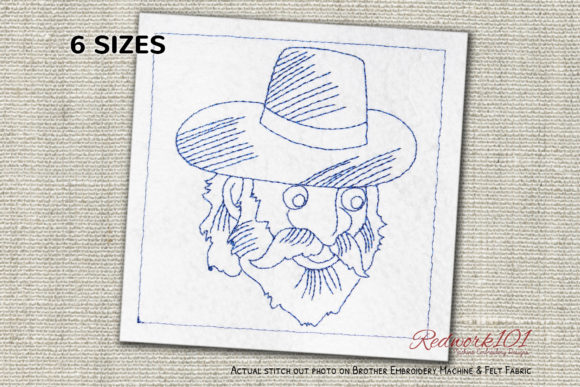
The moment you see the preview, the character jumps off the screen. The big mustache is the star here, giving the face an instant sense of humor and warmth. Unlike generic avatar designs, this has a specific narrative voice. It suggests a story about hunting, nature, or perhaps just a love for the great outdoors. The redwork style—where the entire image is stitched in a single color, usually red but adaptable to any thread—is timeless. It relies on the negative space and the strength of the outline rather than shading or gradients. This makes it incredibly versatile for creating cohesive product lines where color consistency matters more than photorealism.
Visually, the layout is balanced. The face is centered, allowing it to sit comfortably on various surfaces without feeling cramped. There is a subtle texture implied by the stitching lines, which adds depth even though the design itself is flat. For a small business owner looking to create branded merchandise, this kind of distinct visual identity is gold. It is not just a graphic; it is a brand element that customers can recognize instantly.
Real-World Application: From Screen to Stitch
I recently tested this design on a custom order for a boutique that specializes in outdoor gear and gifts. They needed a logo for their new line of canvas tote bags and kitchen towels. We started with the standard setup, but the true test came when we moved to the actual fabric. The Hunter Face with Big Moustache Redwork performed exceptionally well on heavy cotton canvas. The clean lines held up perfectly against the coarse weave, proving that the digitization accounts for fabric texture effectively.
Imagine applying this to a sweatshirt for a local hunting club or a baby onesie for a nursery theme. The boldness of the outline ensures that the design remains legible even from a distance. On a tote bag, it creates a striking focal point that doesn't require expensive metallic threads or complex layering to look professional. For Etsy sellers and craft fair vendors, this design offers high perceived value with relatively low production costs. A simple black or navy thread on a white background creates a sophisticated contrast, while a bright red thread on denim gives it that authentic, rugged feel.
However, the versatility extends beyond apparel. I envision this design thriving on embroidered patches for jackets or as a decorative accent on aprons in a custom kitchen shop. The option mentioned in the description regarding the outer box stitch is a clever touch. If your project requires a border to contain the design or add structure, having that optional element allows you to adapt the file to different framing needs without needing to re-digitize the core artwork. It shows thoughtful consideration for the end user's workflow.
Technical Performance and Stitch Clarity
From a technical standpoint, the execution of this embroidery file is solid. The use of running stitches for the outlines provides a hand-stitched aesthetic that is highly sought after in the handmade community. There are no overly dense fill areas that could cause puckering, which is a common issue with portrait-style designs. The stitch density appears calibrated to allow the fabric to breathe, ensuring that the finished product retains its drape and softness.
When working with machine embroidery design, one of the most critical factors is how the design interacts with the stabilizer. Because this design relies heavily on continuous lines, using a cut-away stabilizer is recommended for stretchy fabrics like t-shirts or caps to prevent distortion during wear and washing. For woven items like pillow covers or tea towels, a tear-away might suffice, but testing on scrap fabric is always the golden rule. The clean edges of the mustache and facial features suggest that the underlay stitches were placed strategically to anchor the top layers securely.
One aspect to note is the "bluework" mention in some descriptions versus the "redwork" title. This simply refers to the color of the thread used for the demonstration. In practice, you can swap the thread color to match any palette. Whether you choose a deep forest green for a woodland theme or a soft beige for a neutral nursery, the design structure supports a wide range of thread colors. The visual appeal remains consistent regardless of the hue chosen, making it a reliable asset for commercial embroidery projects where brand colors must be strictly adhered to.
Where to Use Caution
While this design is robust, it is not without limitations. Small hoop sizes present a challenge. If you attempt to stitch this on a tiny item like a child's sock or a miniature patch, the details of the mustache might get lost or become too crowded. Always check your hoop size requirements before committing to a small format. Additionally, textured fabrics like bouclé or heavy corduroy can obscure the fine lines of the running stitches, so smooth surfaces are preferable.
Dense stitch areas are generally avoided here, which is good, but if you plan to embroider over existing seams or on curved surfaces like baseball caps, you must ensure the curvature does not distort the facial proportions. The design works best on relatively flat planes. Also, consider the washing frequency. While redwork is durable, frequent industrial washing can eventually soften the crisp lines, so advise clients to wash delicate items inside out or on gentle cycles to preserve the finished product's integrity.
Designer Notes for Success
Before adding Hunter Face with Big Moustache Redwork to your final collection, I strongly recommend running a test on scrap fabric. This allows you to verify the stitch density and ensure that the tension is correct for your specific machine and thread type. Check the contrast between your chosen thread and the fabric; a light thread on light fabric will disappear, while a dark thread on dark fabric might lack definition. A black and white mockup can help visualize this before you even load the bobbin.
If you are a digital product seller, remember to review the licensing terms carefully. Confirm whether the design is intended for personal use only or if it allows for commercial sale of physical goods. Many creators build their businesses on these assets, so understanding the legal boundaries is crucial. Also, inspect the small details closely. Sometimes, the corners of the box or the tips of the mustache may need slight trimming or adjustment depending on your desired finish.
Ultimately, this design is a testament to the power of minimalism in embroidery projects. It proves that you don't need thousands of colors to create a memorable piece. By focusing on strong lines and clear shapes, Hunter Face with Big Moustache Redwork becomes a tool that empowers designers, makers, and entrepreneurs to create high-quality, personalized gifts and products with confidence. Whether you are launching a new line of handmade products or simply want to upgrade your own wardrobe, this design offers a blend of charm and practicality that is hard to beat.